(And Why That’s Not Resistance)
There are few phrases that can quietly derail a therapy session like this one:
“I don’t know.”
- It can land softly or sharply.
- Sometimes it’s whispered. Sometimes it’s brisk.
- Sometimes it follows a long pause; sometimes it arrives immediately, as if rehearsed.
And often, something happens inside the therapist.
We might feel momentarily stuck.
We might try another angle.
We might gently probe, rephrase, offer options.
Or – if we’re honest – we might wonder whether the client is avoiding something, withholding, or simply not engaging.
In many therapeutic models, “I don’t know” is subtly treated as an obstacle to move past.
In attachment-informed work, it’s often understood very differently.
Because more often than not, “I don’t know” is not resistance at all.
It’s communication.
When not knowing is the safest answer
For many clients, particularly those with developmental or relational trauma histories, not knowing has been an essential survival strategy.
Knowing what they felt.
Knowing what they needed.
Knowing what was happening inside them.
These were not neutral activities in early life. They were often dangerous.
In environments where emotions were dismissed, punished, ignored, or overwhelmed caregivers, children learned quickly that awareness itself could be risky.
So the nervous system adapted.
Not knowing became a way of staying safe.
A way of staying connected.
A way of avoiding conflict, rejection, or emotional flooding.
By adulthood, this strategy is no longer conscious. It’s automatic, embodied, deeply familiar.
So when a client says “I don’t know”, they may not be refusing to engage – they may be doing exactly what once kept them safe in relationship.
The limits of insight-based questioning
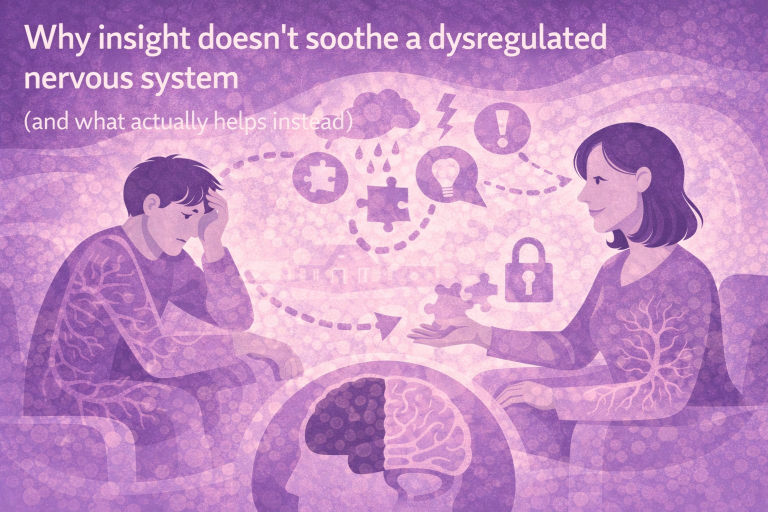
Many counsellors are skilled at asking thoughtful, open questions. But when those questions are aimed at parts of the self that never learned it was safe to know, they can unintentionally increase threat.
The client might feel:
- Pressured
- Exposed
- Silly for not having an answer
- Afraid of “getting it wrong”
And when threat increases, access to reflection decreases.
This is one of the moments where therapists can feel subtly ineffective – asking good questions that somehow don’t land.
The issue isn’t the quality of the question.
It’s the developmental level of the part being asked to answer.
You’re not speaking to a reflective adult self.
You’re often speaking to a much younger part whose job was to not know.
The nervous system before language
It’s worth remembering that the parts of the brain responsible for self-reflection and narrative develop later than those responsible for survival.
When early experiences are chaotic or unsafe, emotional responses are stored implicitly – in the body, in sensation, in relational expectation – rather than in words.
So when clients are asked how they feel, or what something means to them, the nervous system may simply draw a blank.
Not because there is nothing there – but because it was never encoded in language.
From this perspective, “I don’t know” is not emptiness.
It’s pre-verbal experience.
What happens inside the therapist
These moments can be surprisingly activating for therapists.
“I don’t know” can evoke:
- A sense of pressure to do something
- Anxiety about running out of time
- Doubt about our competence
- A pull to rescue, explain, or educate
All of which are understandable.
But attachment-informed work invites us to pause and ask a different question – not about the client, but about the relational moment itself.
What might this ‘not knowing’ need right now?
Often, the answer is not another question.
Meeting “I don’t know” with curiosity, not urgency
One of the most regulating responses to “I don’t know” is to treat it as meaningful in its own right.
Not as a problem to solve, but as information.
You might notice:
- The client’s posture
- Their breathing
- A shift in tone
- A sudden stillness or agitation
These cues often tell you far more than words could.
Sometimes the most attuned response is something like:
- “Let’s slow this down.”
- “Something here might feel hard to reach.”
- “We don’t have to know yet.”
These aren’t techniques – they’re relational signals.
They communicate:
You’re not failing.
There’s no rush.
You’re safe to stay exactly where you are.
And for clients whose early experiences taught them that not knowing was dangerous, this can be quietly transformative.
When not knowing becomes knowing
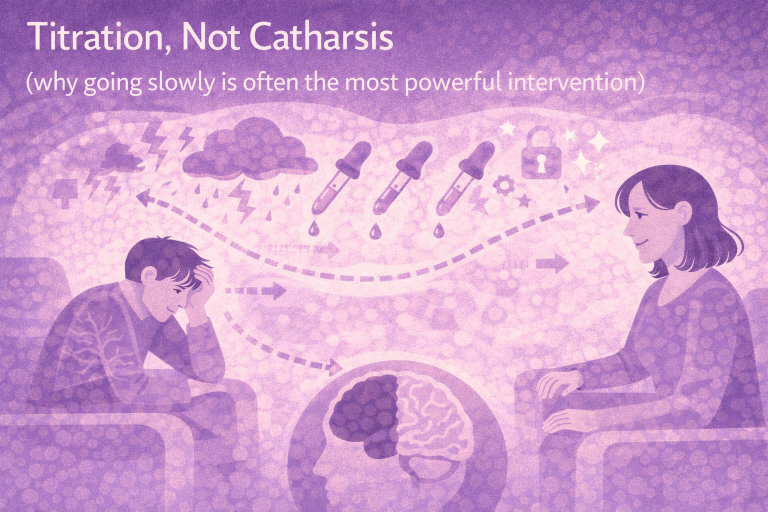
Ironically, it’s often when the pressure to know is removed that something begins to emerge.
A sensation.
An image.
A feeling without words.
A younger part peeking out cautiously.
This is where attachment work often moves away from content and towards process – noticing what happens between client and therapist in real time.
Not knowing, held safely, can become the beginning of awareness rather than its absence.
A different measure of progress
In attachment-focused work, progress isn’t always marked by insight or articulation.
Sometimes progress looks like:
- Staying present a few seconds longer
- Not shutting down immediately
- Naming “I don’t know” without shame
- Trusting the therapist enough to pause
These are not small things.
They are signs that the nervous system is beginning to soften – that safety is slowly replacing vigilance.
A reflection to carry forward
The next time a client says “I don’t know”, you might gently wonder:
- Who learned that knowing wasn’t safe?
- What might happen if this didn’t need to be answered today?
- What does my own response to ‘not knowing’ tell me?
In my experience, when therapists stop treating “I don’t know” as a dead end, it often becomes a doorway.
Not into answers – but into relationship.
And in attachment work, that’s where the most meaningful change begins.
In the next blog, we’ll explore what’s really happening when clients seem to “overreact” – and how the nervous system can help us make sense of responses that otherwise feel disproportionate or puzzling.
For now, you might simply notice this:
What happens inside you when a client says, “I don’t know”?
Often, that’s where the work begins.