There’s a moment many counsellors recognise, even if we don’t always say it out loud.
A client does the thing again.
- They cancel last minute.
- They spiral after what seemed like a good session.
- They push for reassurance, then dismiss it.
- They nod thoughtfully… and return the following week unchanged.
And somewhere inside us – usually quietly, a thought flickers:
Why does this keep happening?
It’s often at this point that behaviour starts to feel like the problem.
We might dress it up in kinder language – resistance, avoidance, defences – but underneath, there can be frustration, confusion, even a sense of inadequacy. Especially when we’re doing everything we were trained to do.
This is often where attachment work invites a profound shift.
Because from an attachment – informed perspective, behaviour is never the problem.
It is the clue.
When behaviour stops making sense
Most core trainings equip us well to work with thoughts, emotions, patterns and insight. What they don’t always prepare us for is what happens when none of that seems to touch the edges of what’s unfolding in the room.
- You can see the client understands.
- They can articulate their history.
- They can name the pattern.
And yet – something deeper remains untouched.
When we stay focused on behaviour alone, it’s easy to ask questions like:
- Why won’t they change?
- Why do they keep sabotaging progress?
- Why does this feel so hard?
Attachment thinking quietly reframes those questions into something far more useful:
- What is this behaviour protecting?
- What had to happen for this to make sense?
- Who did this behaviour once keep safe?
Because behaviour, when viewed developmentally, is not chosen.
It is learned.
Behaviour as survival, not pathology
Many of the behaviours that bring clients into therapy were once ingenious solutions to impossible relational situations.
The client who clings learned that proximity was the only protection against abandonment.
The client who withdraws learned that needing others led to disappointment or danger.
The client who intellectualises learned that feelings overwhelmed everyone involved.
Seen through this lens, behaviour stops being something to fix and starts becoming something to understand.
And understanding changes everything – including how we, as therapists, feel in the room.
When we shift from “Why are they like this?” to “What is this behaviour trying to prevent?”, frustration often softens into curiosity. Not indulgent curiosity – but clinically precise, ethically grounded curiosity.
The nervous system is always ahead of the story
One of the reasons behaviours can feel so baffling is that it is often driven by parts of the nervous system that operate well outside conscious awareness.
Clients don’t first think their way into behaviours.
They feel them – somatically, instinctively, relationally.
- A raised voice.
- A blank stare.
- A sudden urge to please.
- A wave of panic that seems to come from nowhere.
By the time words arrive, the body has already decided whether the situation feels safe, dangerous, or familiar in all the wrong ways.
This is why insight alone so often fails to create change – and why therapists can feel stuck despite doing thoughtful, attuned work.
Behaviour isn’t responding to logic.
It’s responding to perceived threat.
The child inside the behaviour
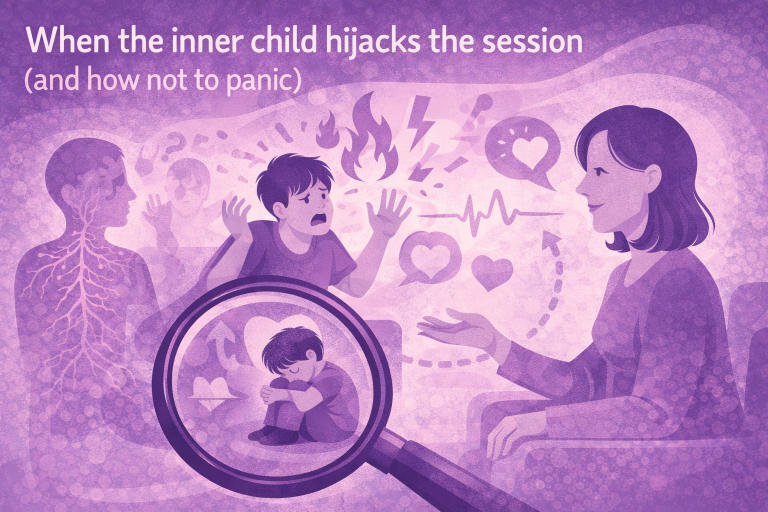
When we look closely, many behaviours are not expressions of the adult sitting in front of us – but of a much younger part who learned, very early on, how to survive relationships.
This isn’t metaphorical.
Developmental trauma research shows us that when early attachment needs are unmet, parts of the self can become frozen in time – still responding as if the original conditions apply.
So when a client reacts “out of proportion”, they often aren’t overreacting at all. They are reacting accurately – to a world their nervous system still believes exists.
Understanding this doesn’t mean colluding with harmful behaviour or abandoning boundaries. It means we stop addressing the behaviour as if it exists in isolation.
Instead, we begin to ask:
- How old does this response feel?
- What might this part of the client be afraid would happen otherwise?
- What does this behaviour know that the adult self does not yet trust?
These questions open doors that behavioural strategies alone rarely touch.
What this asks of us as therapists
Here’s the quiet, often unspoken truth:
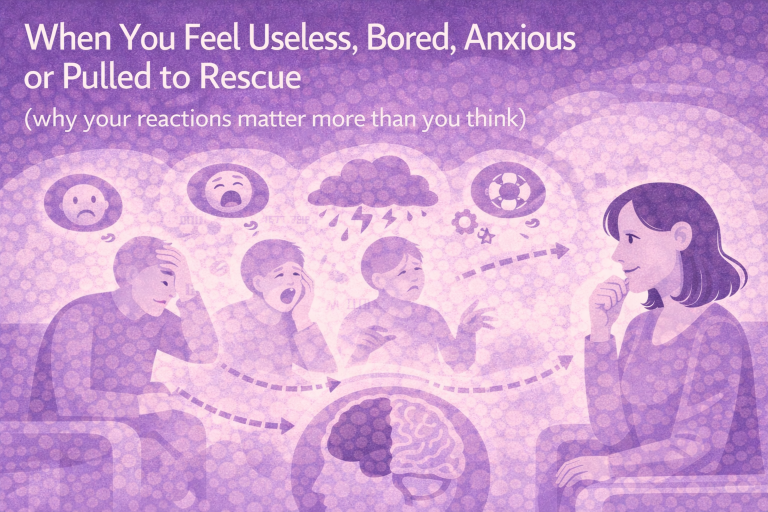
- When behaviour is misunderstood, therapists tend to internalise the difficulty.
- We question our competence.
- We work harder.
- We add more techniques.
We subtly brace ourselves for the next session.
Attachment – informed work gently returns us to a different stance.
Instead of asking “What should I do next?”, we begin to ask:
- What is being communicated here, without words?
- What is the relationship asking for right now?
- What might help this client feel just enough safety to soften?
This isn’t about abandoning skills. It’s about using them in service of something deeper – the client’s internal world, shaped in relationship and revealed through behaviour.
A different way of listening
Once you start listening to behaviour as information rather than obstruction, sessions change.
- You listen differently.
- You pace differently.
- You feel less pulled to fix and more able to stay present.
Clients often sense this shift before they can name it. Something in the room feels less pressured, less evaluative, more curious.
And slowly – often unexpectedly – behaviour begins to change. Not because it was targeted directly, but because the conditions that once required it start to soften.
A final reflection
If behaviour is the clue, then the work of therapy becomes less about correcting and more about decoding.
That decoding takes time, practice, and a framework that helps us think developmentally, relationally, and somatically – especially when the work stirs our own uncertainty.
Many counsellors tell me that discovering attachment – focused ways of working feels like learning a new language – one that suddenly makes their clients (and their own reactions) make sense in a way they hadn’t before.
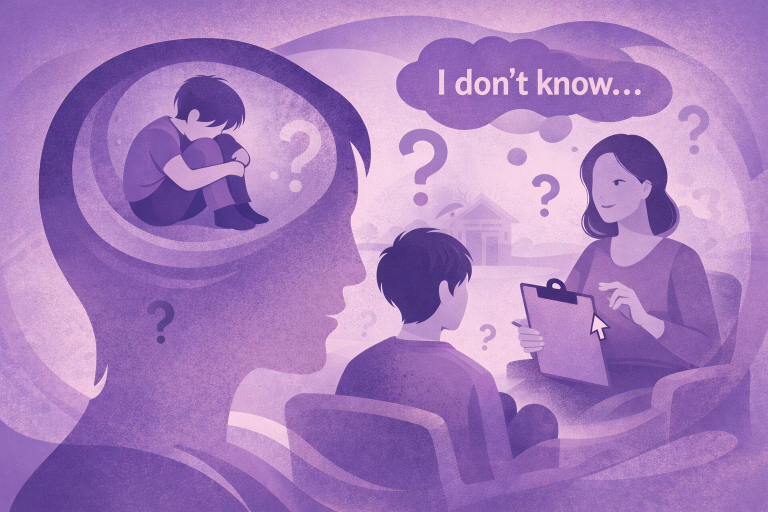
Look out for the next blog, we’ll explore what’s really happening when clients say “I don’t know” – and why, in attachment work, that phrase is often a doorway rather than a dead end.
What behaviour has been puzzling you lately – and what might it be trying to protect?
Sometimes, that question alone changes the session