(And How Not to Panic)
There are moments in therapy when something shifts suddenly.
A client who was reflective becomes overwhelmed.
Tears escalate quickly.
Words disappear.
The room feels tighter, louder, more urgent.
And inside the therapist, a familiar response can arise:
I’ve lost them.
This is too much.
I need to do something – now.
This is often the point at which therapists say, later in supervision,
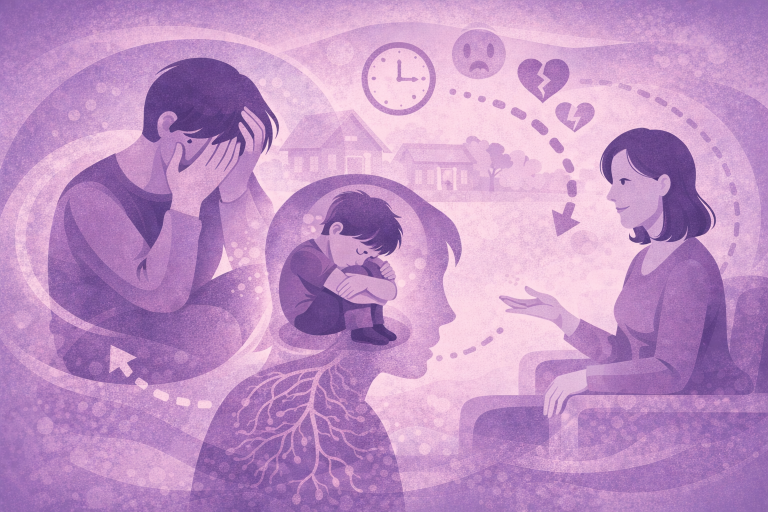
“It felt like the inner child took over.”
They’re usually right.
But the problem isn’t that the inner child showed up.
The problem is what happens next.
When younger parts come forward
When inner child material emerges strongly in session, it’s rarely planned.
It doesn’t arrive neatly labelled or politely timed.
It often appears when:
- Something feels misunderstood
- A boundary is introduced
- Closeness increases
- The client feels exposed or seen
From a developmental perspective, this makes sense.
Younger parts of the self come forward when they sense risk or opportunity. Risk of abandonment. Opportunity for connection. Often both at once.
What looks like “hijacking” is usually a part of the client responding very quickly to a perceived relational moment.
The nervous system has moved into survival mode.
Why therapists panic (and why that matters)
When intensity rises, therapists often experience their own nervous system response.
We may feel:
- Pressure to regulate the client
- Anxiety about getting it wrong
- Fear of overwhelming the client
- A pull to rescue, soothe, or explain
This internal rush can be subtle or strong – but clients feel it.
When the therapist becomes hurried, overly active, or suddenly distant, the younger part of the client often escalates further.
Not because the therapist has failed – but because the nervous system reads urgency as danger.
The key issue isn’t the client’s reaction.
It’s whether the therapist can stay regulated enough to hold it.
Regulation before relationship repair
In moments like these, it’s tempting to reach for meaning.
To ask:
- “What’s coming up for you?”
- “Does this remind you of something?”
- “What are you feeling right now?”
But when a client is emotionally flooded, these questions often land too high.
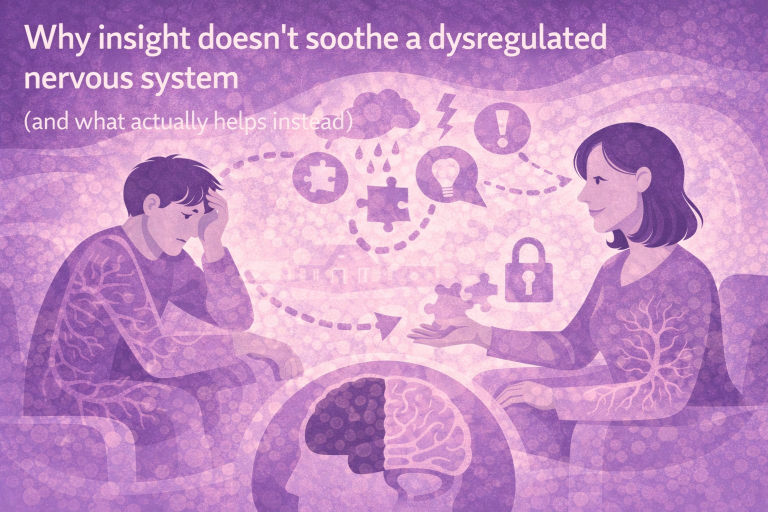
The reflective brain isn’t online.
Attachment-informed work prioritises regulation before exploration.
This might mean:
- Slowing your speech
- Reducing verbal input
- Naming what you see without analysing it
- Inviting grounding through the body
- Simply staying present and steady
These responses aren’t passive.
They communicate something crucial:
I’m not overwhelmed by this.
You don’t have to manage it alone.
We says with you.
When “doing less” is actually doing more
One of the hardest shifts for therapists is learning that less intervention can be more containing.
Not every intense moment needs to be worked through immediately.
Not every feeling needs meaning-making.
Not every child part needs to speak.
Sometimes, the most therapeutic act is allowing the intensity to settle while maintaining connection.
This helps the client’s nervous system learn something new:
that strong emotion doesn’t automatically lead to rupture, abandonment, or loss of control.
That learning happens through experience – not explanation.
Avoiding two common traps
When inner child material hijacks a session, therapists often fall into one of two traps:
- Over-intervention
Too many questions, techniques, or interpretations – driven by anxiety rather than attunement. - Withdrawal
Becoming quieter, more distant, or overly neutral in an attempt to contain. Both can leave the client feeling alone with something very young and very vulnerable.
The middle path is regulated presence – engaged, steady, and responsive without being intrusive.
Boundaries still matter here
Staying with inner child material does not mean abandoning structure or boundaries.
In fact, boundaries are often what help younger parts feel safe.
This might include:
- Gently slowing the pace
- Naming time limits
- Holding the frame of the session
- Resisting the urge to rescue
Containment is not about control.
It’s about providing a predictable relational environment in which emotion can rise and fall safely.
A different way of understanding “hijack”
What if we stopped seeing these moments as disruptions?
What if we understood them as contact points – moments when something vulnerable has trusted the relationship enough to appear?
That doesn’t mean we rush in.
It means we meet the moment with steadiness rather than fear.
Over time, clients learn:
- Their feelings won’t overwhelm the therapist
- They don’t have to escalate to be noticed
- Younger parts don’t need to take over to be held
And sessions become less chaotic – not because the child disappears, but because it no longer needs to shout.
A reflection to carry into practice
You might gently reflect on this:
- What happens in your body when a session tips into intensity?
- Where do you feel pulled to act quickly – or to pull away?
- What helps you return to a regulated, grounded presence?
Inner child moments don’t require perfection.
They require steadiness.
In the next blog, we’ll explore what it means to repair after these moments – and why what happens after intensity often matters more than the intensity itself.
For now, you might simply notice this:
What changes when you trust that the work isn’t to stop the child from appearing – but to stay present when it does?
Often, that’s where therapy becomes most alive.