

Attachment-Focused Learning On-Demand
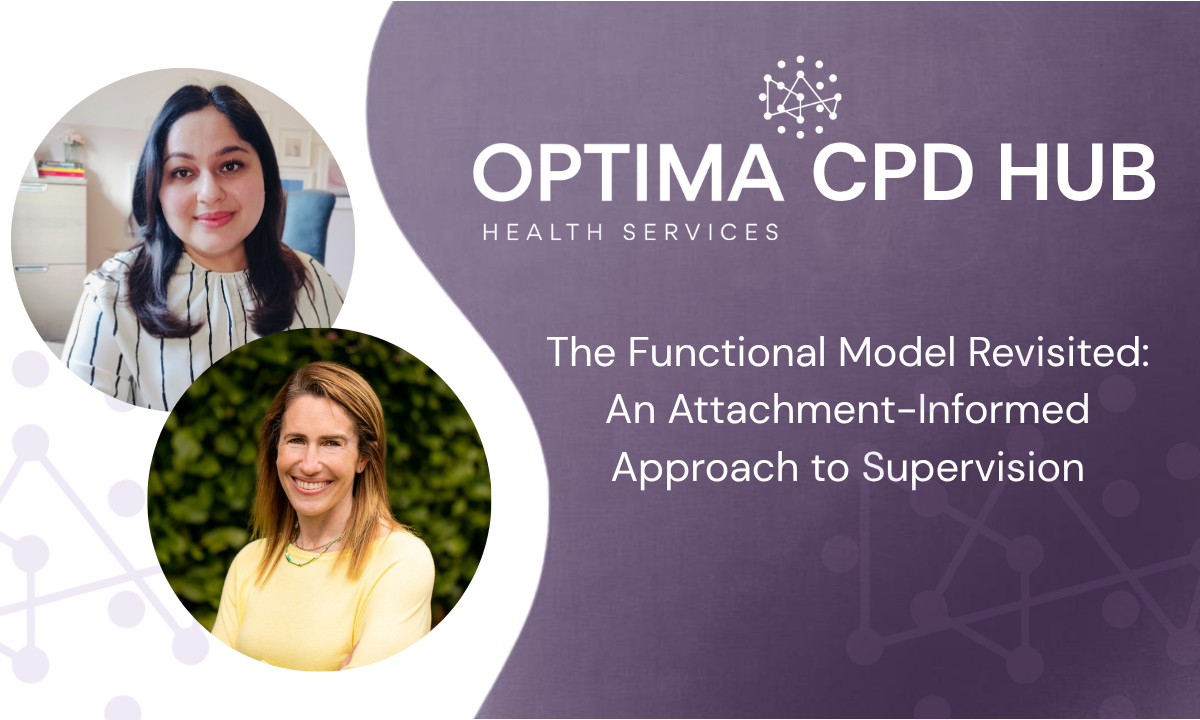
Attachment-Informed Supervision: The Functional Model Revisited
⏰ 1 hour with reflection £9.99The Functional Model Revisited: An Attachment-Informed Approach to Supervision
Tutors: Uruj Anjum and Georgina Sturmer
In this workshop, Uruj Anjum and Georgina Sturmer revisit the Functional Model of supervision and explore what happens when it is viewed through an attachment-informed lens.
The session begins with the three functions of supervision developed by Francesca Inskipp and Brigid Proctor: formative, normative and restorative. Uruj and Georgina explain these as the learning and development function, the ethical and accountability function, and the emotional support and containment function. Rather than treating these as three tidy columns, they explore how the functions often overlap within real supervision sessions.
A key focus of the workshop is the idea that supervision does not land in neutral space. It lands in people, with histories, identities, relationships to authority, and different levels of comfort with being seen, challenged or supported. The tutors explore how supervision can feel stretching, exposing, collaborative, comforting or frustrating – sometimes all at once.
The workshop then brings in attachment theory, considering supervision as both a secure base and a safe haven. Uruj and Georgina look at how supervisees may lean towards different functions depending on their attachment strategies. Avoidant tendencies may lead supervisees to stay in intellectual, formative or normative spaces, while anxious tendencies may seek reassurance through the restorative function. Supervisors also bring their own attachment patterns, which can shape whether they over-support, avoid challenge, move too quickly into teaching, or struggle with restorative work.
The session also explores power, culture and identity in supervision. Uruj and Georgina invite supervisors and supervisees to think not only about difference, but about how power operates in the room: whose voice is centred, whose knowledge is valued, and how accountability can be offered without shame.
Through role plays, and reflection, the workshop brings the model to life with examples of anxious and avoidant patterns in supervision. The emphasis is on using the Functional Model as a structure, while also noticing safety, threat, power and the nervous systems in the room.
Key clinical themes
- The Functional Model of supervision: formative, normative and restorative
- How the three functions overlap in real supervision
- Supervision as more than a case presentation
- Supervision as a secure base and safe haven
- How attachment patterns shape the experience of supervision
- Avoidant strategies: intellectualising, minimising and staying in thinking
- Anxious strategies: reassurance-seeking, self-doubt and fear of getting it wrong
- How supervisors’ own attachment patterns affect the work
- The role of power, culture and identity in supervision
- Accountability without shame
- Difference, hierarchy and the impact of being seen
- Using attunement to move safely between the three functions
This recording is suitable for supervisors, supervisees and therapists who want to think more deeply about supervision as a relational, ethical and attachment-informed space.
PLEASE NOTE: The time of the recording has been adapted from a live session and includes time for reflection!
Understanding and Working with Avoidance in Adult Relationships
⏰ 1 Hour with reflection £9.99Understanding and Working With Avoidant Attachment in Adult Relationships
Tutor: Georgina Sturmer
In this workshop, Georgina Sturmer explores how avoidant attachment shows up in adult relationships, and how therapists can support clients to understand the patterns that keep them distant from others.
Georgina begins with a clear introduction to attachment as an internal “alarm system”. When life feels stressful, threatening or emotionally exposing, avoidantly attached clients may protect themselves by moving away, becoming self-reliant, shutting down feelings, or keeping others at a distance. On the outside, this can look calm, confident and capable, but underneath there may be fear of rejection, dislike, vulnerability or being overwhelmed by closeness.
The session looks at how avoidant attachment can affect romantic relationships, family relationships, friendships, work relationships and the therapeutic relationship itself. Georgina uses the case example of Bob and Sarah to explore the relational “dance” that can happen when one person seeks closeness and the other withdraws. She invites therapists to think about what this dance might feel like for the client, for the other person, and for the therapist in the room.
A strong focus of the workshop is on helping clients slow down and notice what happens in the moment their attachment alarm goes off. Rather than trying to change behaviour straight away, Georgina encourages curiosity about what feels threatening, what the client imagines is being asked of them, and why distance begins to feel like the safest option.
The workshop also explores practical ways of working with avoidant attachment, including attunement, co-regulation, mentalisation, psychoeducation, the Parent-Adult-Child model, inner child work, body awareness and metaphor. Georgina shows how therapists can help clients understand their need for space without using it as an attack, and how they can begin to recognise the emotional cost of always protecting themselves through distance.
Ultimately, this session is about increasing safety rather than forcing vulnerability. When avoidantly attached clients feel safe enough, the dance can begin to change — not because they are pushed into closeness, but because they no longer have to dance alone.
Key clinical themes
- Understanding avoidant attachment as protection
- Attachment as an internal alarm system
- How avoidance shows up in adult relationships
- The link between closeness, alarm and withdrawal
- Working with clients who minimise, intellectualise or use humour
- Using the metaphor of the relational “dance”
- Understanding pursuer-withdrawer dynamics
- Exploring the therapist-client relationship with avoidant clients
- Supporting mentalisation and curiosity about others’ feelings
- Using psychoeducation without encouraging over-intellectualising
- Working with the Parent-Adult-Child model
- Exploring younger parts and inner child work when safety has been built
- Helping clients notice body signals when their alarm goes off
- Increasing safety so vulnerability can become more possible
This recording is suitable for therapists and counsellors who want to understand avoidant attachment in adult relationships and work more confidently with clients who protect themselves through distance, self-reliance and withdrawal.
PLEASE NOTE: The time of the recording has been adapted from a live session and includes time for reflection
Becoming Research Confident: A Therapist’s Path to Level 7
⏰ 1 Hour with reflection £9.99Becoming Research Confident: A Therapist’s Path to Level 7
Tutor: Uruj Anjum
In this workshop, Uruj Anjum invites therapists to think about research in a way that feels more human, accessible and rooted in clinical practice.
Rather than presenting research as something distant or purely academic, Uruj begins with the idea that research often starts in the therapy room. Therapists are already noticing patterns, asking why certain dynamics emerge, wondering what helps clients, and making meaning from what unfolds in the work. In this sense, research is framed as structured curiosity.
The session gently demystifies different types of research, including quantitative research, qualitative research, systematic reviews, mixed methods, case studies, practice-based research and clinical trials. Uruj offers simple explanations of what these approaches involve, and how some may feel closer to the way therapists already think and work.
A key focus of the workshop is helping therapists reflect on their own relationship with research. Uruj explores how words like “research” can bring up curiosity, doubt, avoidance, perfectionism, fear of getting it wrong, or memories of earlier academic experiences. She also looks at what Level 7 study involves, including critical thinking, engaging with literature, developing an independent research project, and integrating reflection with academic thinking.
The workshop includes a reflective exercise and breakout discussion to help participants identify areas of clinical curiosity. Uruj encourages therapists to notice the questions that already live in their practice, and to begin imagining how those questions might be shaped into research.
Uruj also shares her own research journey, from working as an NHS research genetic counsellor across multiple studies, through to her current systematic review exploring the intergenerational psychological effects of having a parent with Huntington’s disease.
This recording is suitable for therapists and counsellors who feel curious about research, interested in Level 7 training, or unsure whether they are “academic enough” to take the next step.
Key clinical themes
- Research as structured curiosity
- Recognising the research skills already present in therapy practice
- Understanding different types of research in simple terms
- Exploring the difference between literature reviews and systematic reviews
- Reflecting on fear, doubt, confidence and avoidance around research
- Understanding what Level 7 study involves
- Moving from clinical curiosity to research question
- Bridging therapeutic identity and research thinking
- Using systematic review to gather and make sense of existing knowledge
- Seeing research as human, relational and connected to practice
This workshop offers a gentle and encouraging introduction for therapists who want to become more research-confident and begin imagining a pathway toward Level 7 study.
PLEASE NOTE: The time of the recording has been adapted from a live session and includes time for reflection
Attachment and Burn Out Who Holds The Therapist
⏰ 1 Hour with reflection £9.99
Avoidant Attachment in the Therapy Room
⏰ 1 Hour with reflection £9.99
When Autism Meets Attachment in the Therapy Room
⏰ 2 Hours with reflection £9.99Autism & Attachment in the Therapy Room
Tutor: Darren Sharpe & Jo Oxley
In this 2.5 hour training, Darren Sharpe explores the intersection between autism and attachment in the therapy room, with a focus on helping therapists avoid misreading autistic clients and adapt practice in ways that support safety and engagement.
The session begins by framing autism as a lifelong neurodevelopmental difference, with highly variable presentations. Darren introduces key ideas including the spectrum model, the neurodiversity perspective, and differences in communication, social interaction and flexibility. The training invites therapists to consider which behaviours in therapy may be autistic traits rather than resistance, disengagement or emotional avoidance.
A strong focus of the workshop is sensory processing and the nervous system. Darren explores how sensory sensitivity or sensory seeking can shape emotional regulation, relational safety and therapy engagement. Participants are encouraged to think about behaviour as communication, and to ask what the client’s nervous system may be communicating in the room.
The training also includes an attachment theory refresher, looking at secure, avoidant, ambivalent/anxious and disorganised attachment patterns. Darren then explores where autism and attachment can overlap, and how autism may sometimes look like attachment difficulty. For example, reduced eye contact may be about sensory regulation, independence may be misread as avoidance, and literal communication may be mistaken for emotional distance.
A key part of the session focuses on therapy-room misreads. Darren invites therapists to reflect on how clients who appear disengaged, distant, avoidant or emotionally unavailable may in fact be overwhelmed, processing, regulating or communicating differently.
The workshop includes case study exploration and practical strategy building. Participants consider clients who speak in monologues, struggle with emotional language, or appear distant but attend consistently. The session then moves into autism-supportive adaptations, including clear structure, predictable pacing, explicit expectations, processing time, sensory adjustments and open repair of misunderstandings.
This recording is suitable for counsellors, therapists and mental health professionals who want to better understand autistic clients through both autism and attachment lenses, and adapt their work to reduce harm and increase therapeutic safety.
Key clinical themes
- Autism as a lifelong neurodevelopmental difference
- Neurodiversity-affirming therapeutic practice
- Understanding highly variable autistic presentations
- Sensory processing and nervous system safety
- How sensory safety supports relational safety
- Attachment patterns in the therapy relationship
- Where autism and attachment may overlap
- Avoiding misreads around eye contact, distance and engagement
- Understanding behaviour as communication
- Working with clients who appear distant but attend consistently
- Adapting therapy through structure, clarity and predictability
- Supporting emotional language and processing time
- Reducing sensory load in the therapy room
- Using both autism and attachment lenses in formulation
This training offers practical, reflective guidance for therapists who want to work more confidently and safely with autistic clients in the therapy room.
PLEASE NOTE: The time of the recording has been adapted from a live session and includes time for reflection
Share Your Experience
Testimonials are reviewed before publishing — your words help other therapists find the right CPD.